Showing posts with label Typesetting. Show all posts

5/26/11

...Now in Wallpaper Form!

Remember that poster from yesterday? It's now available as a wallpaper! Download to your heart's content.

(Click on the thumbnails for full-resolution images.)


From top to bottom:
1024 x 768
1280 x 800
1440 x 900
1920 x 1080

5/25/11

You are Going to ______ Today


Illustrator CS5; set in Bodoni; paper size: 0.7 m x 1.0 m

Something quick 'n' dirty. Set on a 5 x 5 grid rotated fifteen degrees.

Jet Travel in the Age of Saarinen


India ink and graphite on newsprint;
compositing, layout and post-processing in Illustrator and Photoshop;

full/actual paper size: A0 (~0.8m x 1.1m)

Today's nostalgia for a more...civilized era of air travel is easy to understand. Who, after all, can resist the thought of sleek Eero Saarinen terminals, equally streamlined airplanes, and crisply attired captains and stewardesses (not to mention other amenities like free in-flight meals) in an age when air travel has been debased to the level of a mostly thankless, pedestrian, and at times intrusive ordeal? Sure, airfare was more expensive before the fragmentation and deregulation of the airline industry, but I think one could be forgiven for romanticizing a more tasteful albeit expensive bygone.

On a related note, I'd like to take a moment to address what Steven Heller, whom Gawker termed "some expert" (fat lot they know about design!), wrote for Print Mag's blog, where he pointed out some cursory similarities between the claustrophobic layouts of modern jetliners and slave ships. Now, before you sentimental lefty PC-types reach for your pitchforks, allow me to say that Mr. Heller probably intended the post to be more lighthearted (it's an idle musing, after all, and not a twenty-page term paper) than as perceived.

But is there some kernel of truth behind his casual observation? I wouldn't call air travel degrading (though like I said before it's a far cry from what it used to be), but the notion of maximizing carrying capacity and spacial economy in both instances necessarily comes at the passenger's expense. That is, in both instances a similar (though hardly identical) comprehension of the passenger as cargo obtains.

The principal difference here is a function of motivation--by which I mean contempt for the persons transported. Rationally-minded airline planners might not be disposed to view their customers as people (that's the job of the marketing & PR department), but that said they also don't think of them as subhuman beasts. Whatever indignities airlines inflict on their passengers is only ancillary, whereas the depredations slaves-in-transit endured are the consequence of deliberate, calculated oppression, insult, and inhumanity.

The other big difference is pretty obvious: Unlike slaves, airline passengers usually have ready recourse to other modes of transportation. With sufficient funds, they can purchase additional comfort, or, if the distance is not too far and time too urgent a consideration, travel at a more leisurely pace by car or train. Though protracted air travel does wear on the nerves, the longest intercontinental flight also comes nowhere near the duration of an eighteenth-century trans-Atlantic death voyage.

So what about the formal similarities? Well, formal similarities are by definition superficial, and here I think the resemblance is not entirely unwarranted. Apart from diverging choice of icons, I will admit that the two diagrams look alike. But design's significance is, as Mr. Heller knows, informed by context, so the only crime he committed was making a bad airline joke.

4/30/11

Ex Lib.


Above: Menus (front cover and sample inside page)


Business card (obverse & reverse)

Note: You are not at liberty to borrow any of this content for your own purposes or for a third party without my permission.

Full Disclosure: I went to Ex Libris a whopping once during my four years at the University. The cafe itself was not particularly memorable, which is a darn shame when you think about its location (read: The bloody Reg). Given its context, I think that a visual identity overhaul that references its context/surrounding architecture will be part of any large-scale enterprise to improve said establishment's presence and prominence. The goal would be to make Ex Libris a more formal sit-down establishment, a cafe designed for extended stays that would also appeal to new customers who are more familiar with the Reg than its resident cafe.

Having said this, let's begin with the logo, which acknowledges the Reg's shape and texture, as well as the books housed therein and the name of the cafe itself through the thick "hatching" and a simple directional contrast that lends the impression of a cube/rectangular prism extruding out from a surface (the thick hatch marks were also designed to resemble books' spines). The logo can be extended through patterning, and can serve as the basis of a more elaborate but modular system. It can also be used to "frame" photos or other artwork, thereby making it dynamic.

Materials-wise, the business cards and the cover of the menu would be printed on heavy cover paper (or debossed with the logo foil-stamped or UV-coated if budget constraints permit). The menu covers would  form a heavy folder (heavy cover stock laminated over board stock?), which in turn serves as an affordance for the inside pages, printed on light satin A4, this time without varnishing or UV-coating.

I plan on extending this brand into a holistic system (always a fun exercise), so chances are you'll see some designs for signage/environmental work down the road.

4/25/11

Reappraisals: The Maroon


Quick new re-interpretation of the Maroon (top) and old re-design (bottom)
Note: This hypothetical redesign is the property of Tom Tian, and may not be used without his express permission.

Few things are as sobering and edifying as critiquing one's earlier work. I recall revamping the Chicago Maroon's print edition a few years back and thinking that it was the best thing since sliced bread. At the time, it did represent a pretty radical departure from precedent insofar as it attempted to be much more systematic in its type treatment, hierarchy, and layout. It was also more generous in its use of white space, which helped to punctuate and define the content.

Looking back, my runaway indulgence in systematism undermined its long-term reproducibility. Contrast is a good thing, but overuse leads to complex systems that cannot be easily duplicated. Moreover, excessive differentiation risks fragmenting the design into components that do not easily cohere into one product or idea.

With this in mind, if I were to redesign the Maroon again today I'd start with a modular grid and scale; without changing the size of the page, this means setting down a 5 x 8 grid and 3:4 scale, which roughly correspond to the page itself (11:17). Once determined, these relations would then inform my subsequent choices, such as spacing and type size.

Whereas the old redesign was a cacophony of various weights and types (Gotham and Adobe Caslon), the new one would use fewer weights from one family (Adobe Garamond Pro), set flush left to facilitate reading. The modular grid can be thought of as a chart or table of sorts, whereupon horizontal rules of varying weights can serve to divide/partition the page into portions that reflect the importance of whatever content it houses, thereby shifting the burden of differentiation from the type to spacing and layout.

On the non-design side, I would do away with bylines in favor of an expanded masthead; the "topic tags" would also go, as they belong online and have no place in print. The end product is a more modular, parsimonious system that retains the virtues of the older design while curbing its excesses.

4/17/11

Tri-X 2011


Laid out in Illustrator CS5; font: Gotham

I picked up some Tri-X yesterday because my refrigerator's film-to-food ratio was dangerously low, and decided to do a quick 'n' dirty reinterpretation of Kodak's packaging, which looks about as good as their annual earnings report. My version adds more large-small and light-dark contrast, uses a simple 3 x 3 underlying grid and modular scale to lend it a bit more structure, and avoids overly complex gradients in favor of simpler ones. It lacks proper barcodes and icons for recycling, though it's not difficult to see where those would fit.

The logo was more of a quick fix than anything else, and I'm not terribly happy with it.

UPDATE: It occurred to me that the reverse side of the pro pack needs to be flipped so as to display properly once the box is assembled.

3/30/11

Candid Assessments: The Point


Old cover is on the left; my quick reinterpretation, laid out in Illutrator CS5
using Trade Gothic is on the right. Copy unceremoniously borrowed from
The Point's website, so pardon any mistakes.
Cover features
City (Westward) (2008), by Jason Salavon.

I recall looking over a classmate's shoulder once in an art history lecture to find him "designing" a cover for what turned out to be the first issue of The Point. The publication of record is a seldom-released but well curated, reputable (and widely distributed) small-scale journal that attracts good writers owing to its close connections with the University.

Problem is, that's not the impression most people would get upon seeing said magazine for the first time, and the haphazard design is to blame.

The masthead is plagued by the loose leading between the words "THE" and "POiNt," the iffy kerning between the letters "N" and "t," the unsettling disproportion between the counter and bowl of the letters "P" and "O," respectively, and the unnecessary tension between the word "THE" and "POiNt," which, though of disparate size, are equally heavy. I also take issue with the inconsistent use of upper- and lower-case glyphs, which quite frankly just plain contradicts the professionalism of the content within.

As for the teasers, I really can't say much except that I'd prefer it be set flush left, and that the two tiers of teasers could either be set in separate columns or at least use a more generous paragraph break.

I have no idea what the inside pages look like, but the cover's indecisiveness (is it a journal or a magazine?) inspires doubt. I do, however, like the fact that it's printed on something that resembles a standard trade paperback/ISO A4 instead of ANSI A1, which ought to make it slightly easier to read.

Good content deserves good design. Let's hope that changes soon.

On an unrelated note, here's a doodle I made of a happy lumberjack:

3/25/11

Children of the Corn, Part II


11" x 17"; India ink on bristol board; live traced in Illustrator CS5;
some copy set digitally in Trade Gothic


If you're on campus, look out for this poster in the weeks to come. Like the "carpocalypse" design, it, too will adorn a t-shirt, a t-shirt that you absolutely must buy.

1/31/11

Eggs


Illustrator CS5; type: Melbourne

Cobbled this one together in half an hour. If Ikea sold eggs, then they'd probably come in similarly designed boxes.

1/23/11

Hemispheric Defense


Illustrator CS5; font: Melbourne

Not a gradient, bevel, or crappy stock photo in sight, just the way I like it.

9/27/10

Freedom to Design


Adobe Illustrator CS5; font: Univers

I enjoyed Mr. Franzen's novel--the same couldn't be said for the book cover, which I found fairly uninspiring and, I might add, a bit sloppy on the raster work.

5/16/10

Developments

Life is about to get very, very hectic owing to the convergence of some midterms, papers, and projects, so here's something (actually, a lot of things) to distract you until it blows over.

Designed in Adobe Illustrator CS3; Fonts: Romeral & Rockwell; 11" x 17"

I usually don't do figurative drawings in Illustrator because I find vectors too cumbersome for my usual illustrative style, which is more fluid. Some designs call for more precision, however, and I won't hesitate to turn to the program of record for those types of applications.

Designed in Adobe Illustrator CS3; Fonts: Romeral & Rockwell; 11" x 17"

It occurs to me that Archer would've complemented Romeral better than Rockwell, but I don't have a copy of the former, and would rather not shell out the $500 for a basic set.
Designed in Adobe Illustrator CS3; Fonts: Romeral & Rockwell; 11" x 17"


A breakdown of the guides and grid used to construct the stilt walker in the first poster.


India ink and watercolor lampblack wash on bristol board; colors added in Photoshop CS3

Speaking of more fluid illustrations, here's a colored rendition of my previous post, as well as the second part.

Part II:

When I was twenty-one
It was a very good year
For city girls
Who lived up the stair
With all that perfumed hair
And it became undone
When I was twenty-one

3/2/10

Labor of Love/Masochism

Designed in Adobe Illustrator CS3; laid-out in InDesign CS3; font: Helvetica (portrait) and Gotham (headline & body)

I need to stop signing myself up for labor-intensive projects. This lovely, hand-made piece of work took about three hours. God knows how long it'd take if I filled in all the midtones.

2/28/10

Making the Impossibly Boring Easy to Understand

Designed in Adobe Illustrator CS3; Font: Helvetica Neue; Dimensions: 7" x 9" x 1"

Taking something boring--like tidal current tables--and making it appealing is one of the most satisfying aspects of design, and I think it's fair to say that said sense of self-gratification resides entirely in the challenge. Anyhow, I drew the wave pattern several weeks ago for a design that has since faded into the ether--it happens that this was a perfect application, wherefore I ran with it.

Detailed versions of the front & back covers (and the spine) are available below. I decided to keep the back cover clean because there was no point in extending the pattern all the way.
Front Cover
Spine

Back Cover

2/26/10

Preview: Grey City

Designed in Adobe Illustrator CS3; Fonts: Gotham, Nevis, and Annivers
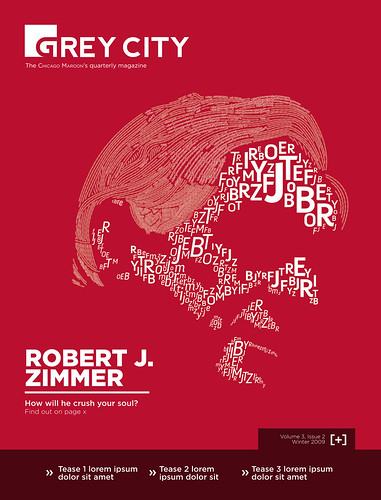
Notwithstanding many and various reservations, I must admit that I will miss working for the Maroon and Grey City, its quarterly magazine. My term as managing editor will end next Thursday, and, quite frankly, I'm not looking forward to the anomie that will no doubt follow. I've been mulling over the prospect of drawing editorial cartoons next quarter, but we'll see.

In the meantime, I'm quite happy with how the cover of this quarter's Grey City turned out--illustrated magazine covers are a rarity nowadays, at least outside the confines of art publications. The general design philosophy elsewhere seems to be one of total imaginative surrender (read: "let's slap a ton of copy onto some photo and call it a day").

Anyhow, the the above illustration was assembled by hand--the weight and physical of the characters describe values from a reference photograph, which I posterized in Photoshop before reproducing it in Illustrtor. The entire process took something in the order of four to five hours, I think.

Designed in Adobe Illustrator CS3 and InDesign CS3; Font: Univers

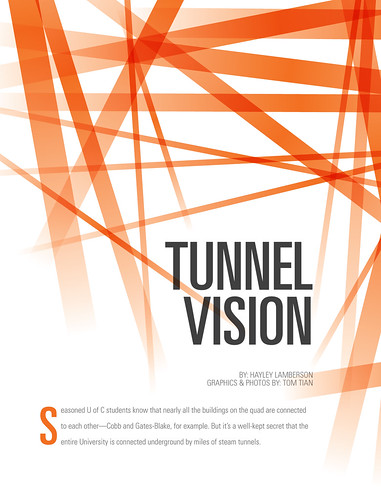
The original lead graphic for the above article was less-than-satisfactory. It involved a vector profile of Rockefeller Chapel that led to some pipes representing the tunnels, which in turn led to the modified letterform "S" of the drop cap. I wasn't enthusiastic about the way the image locked with the copy, and felt that it failed to capture the headline. What you see above is a last-minute change, which, in my estimation, works much, much better.

Nikon D90; 10-24mm f/3.5-4.5; ISO 1600; WB: Auto (A3); minor adjustments in Photoshop CS3; un-cropped version available here

I also took some photos of the steam tunnels for the article of record. They're less remarkable, but shooting in the field is always entertaining.

Nikon D90; 10-24mm f/3.5-4.5; ISO 1600; WB: Auto (A3); minor adjustments in Photoshop CS3; un-cropped version available here

Nikon D90; 10-24mm f/3.5-4.5; ISO 1600; WB: Auto (A3); minor adjustments in Photoshop CS3; un-cropped version available here

11/25/09

Grey City

Grey City: Issue 5
Cover photo by Shahzad Ahsan

Update: A logistical mixup prevented today's issue from being delivered on time. It will be resolved tomorrow.

The fifth issue of the Chicago Maroon's [sleeper] quarterly magazine came out today (download the .pdf version here). I updated its visual identity so that it would be consistent with that of the rest of the Maroon, which I redesigned earlier this year. Apart from story-specific types, the entire magazine is set in various, systematically determined weights of Gotham, which, incidentally, is the Maroon's new san-serif typeface, supplanting Futura.

Like the rest of the paper, the new iteration of Grey City is cleaner and more functional than its previous incarnations. The generously-spaced, two-column inside pages mark, in my estimation, an especially pleasant departure from the stale, early 20th century magazine design of the New Yorker et al. You can find the title spreads I designed (and an inside page) below:

Photo by Camille Van Horne; font: Helvetica Neue

Designed in Adobe Illustrator CS3; laid out and typeset in Adobe InDesign CS3; font: Univers

Photo by Camille Van Horne; fonts: Grafinc Extra Black (with slightly modified letterform "C") and Rockwell


See what I'm talking about? Info-graphic designed in Adobe Illustrator CS3

Designed in Adobe Illustrator CS3; laid-out and typeset in Adobe InDesign CS3; font: Quicksand

Bonus: Exciting content occasions commensurately exciting layouts, wherefore Voices received a double-truck centerfold spread in today's issue (see below).

Not bad for a night's work.
Drawn in Adobe Photoshop CS3 using a Wacom Cintiq 12WX tablet; laid out and typeset in Adobe InDesign CS3; fonts: Museo (titles) and Quicksand (body)

11/5/09

Deterrence Today

Camera: Nikon FE; lens: Nikon AF Nikkor 50mm f/1.8 D; film: Ilford Delta 400 B&W; exposure: 1/125 at f/22; subject is flood-lit using high-power strobes
Designed in Adobe Illustrator CS3 & edited in Photoshop CS3; font: Univers; dimensions: 7" x 11.75"

Disclaimer: "Deterrence Today" is a fake event--please do not show up at Pick 505 on November 7th.

The photograph is of a drop of food coloring diffusing into water, and is part of my intro to photography project on motion. Although I've no intention of printing said take for class (the original is far too small), its graininess lends it a graphite-like quality that commends it to serving as a photo illustration.

11/3/09

Stuck in Knots

Designed in Adobe Illustrator CS3; font: Gotham;
dimensions: 24" x 36"


Disclaimer: "Stuck in Knots: Contemporary challenges in urban planning" is a fictitious event. Please do not show up at Social Sciences 102 on November 8th.

Incidentally, this flier describes my academic life pretty well, since it just occurred to me that the only thing my concentration (political science) will have imparted unto me will be a collection of cocktail party topics. A small but vociferous part of me wishes that I had just studied art from the get-go. Oh, well; at least I can be secure in the knowledge that Habermas et al. will make for good gallery opening party-talk.